
Tea & Threads No. 5
Emerging Currents: Hong Kong Between Memory and Becoming

Tea & Threads offers a curated weekend blend of perspectives, news, ideas, and reflections that shed light on our shifting times — tracing the threads that shape China and the wider world, beyond headlines and noise.
People ∞ Culture ∞ Economics ∞ History ∞ Politics ∞ Philosophy ∞ Art ∞ Environment
The views expressed in articles, lectures, or podcasts published in Tea & Threads are those of the author, lecturer, or speaker, and do not necessarily reflect the views or opinions of China21 Journal.

In a world of many loud voices, it is often wiser to listen, read or observe others than to always speak — for understanding and learning begins not with certainty, but with curiosity.

After all, as Su Shi (1037–1101, 蘇軾), also known as Su Dongpo, a poet, painter, calligrapher, and statesman of the Song dynasty, wrote in his poem “The View from Mount Lu” (題西林壁) nearly a thousand years ago:

不識廬山真面目, 只緣身在此山中。
“We cannot see the true face of Mount Lu, because we are standing within the mountain.”
In this edition of 𝗧𝗲𝗮 & 𝗧𝗵𝗿𝗲𝗮𝗱𝘀 | 𝗪𝗲𝗲𝗸𝗲𝗻𝗱 𝗥𝗲𝗮𝗱𝘀, our lens turns to Xianggang (香港), better known to much of the world as the dynamic city of Hong Kong.
Few places have experienced such profound transformations in recent decades. From its return to the motherland in 1997 after more than 150 years of British colonial rule, becoming a Special Administrative Region of China, to the violent protests and riots of 2019 and 2020, Hong Kong has repeatedly found itself at the center of global attention. The unrest, presumably triggered by opposition to the proposed Extradition Bill—which would have allowed criminal suspects to be extradited on a case-by-case basis to jurisdictions without existing extradition agreements, including mainland China—evolved into a much broader political and social confrontation.
For most media and observers in the West, these events appeared to signal the beginning of the end. Questions emerged about the future of Hong Kong as a global financial center, a leading business hub, and even the viability of the One Country, Two Systems framework itself. Predictions of decline became commonplace.
More than five years later, however, a different picture is emerging.
The city’s famous hustle and bustle is coming back. Hong Kong today records a historic high in locally registered businesses, while the first quarter of 2026 delivered its strongest economic expansion in five years. Business confidence has rebounded, with companies expressing growing optimism about both Hong Kong’s domestic business environment and its role as one of Asia’s most competitive international business hubs, according to the 2026 American Chamber of Commerce Business Sentiment Survey.
Hong Kong’s capital markets are telling a similar story. In 2025, the city raised HK$285.8 billion (US$36.5 billion) through IPOs, reclaiming its position as the world’s leading IPO venue. Equity fundraising was more than three times higher than in 2024, while first-half IPO proceeds alone were nearly seven times the previous year’s level. The momentum has accelerated further into 2026. During the first five months of the year, Hong Kong recorded 62 new listings raising HK$166.8 billion, with IPO fundraising increasing another 111 percent year-on-year.
Tourism is also experiencing a strong revival. After welcoming 44.5 million visitors in 2024, Hong Kong attracted nearly 50 million visitors in 2025, an increase of approximately 12 percent. Growth continued into 2026, with first-quarter arrivals rising a further 17 percent year-on-year. While visitors from mainland China remain the largest group, arrivals from Southeast Asia, Europe, North America, and other long-haul markets are also increasing.
Public sentiment has likewise improved. According to Fidelity’s latest Sentiment Survey, nearly six in ten Hong Kong residents (59 percent) are optimistic about the coming six months, up from 56 percent a year earlier. Positive assessments have risen across work, work-life balance, and personal finances, although concerns about retirement planning remain.
Yet it would be mistaken to interpret this renewed energy as a simple return to the past.
Hong Kong is not becoming what it once was; it is becoming something new. Its business, financial, and capital markets are increasingly linked to emerging sectors such as technology, biotechnology, advanced manufacturing, and other industries connected to China’s industrial transformation. At the same time, the city is becoming ever more integrated into the broader Greater Bay Area ecosystem, creating new opportunities, new flows of people, and new forms of economic and cultural connectivity.
This edition of Tea & Threads therefore looks beyond the familiar metrics of industry, finance, and commerce. It draws on two in-depth articles that explore the quieter transformations reshaping Hong Kong: emerging migration patterns, evolving notions of liveability, a blossoming contemporary art scene, and the deeper societal currents that have taken shape in the years following recent upheaval.
Finally, we revisit the events of 2019 through reviews of two published books that offer contrasting perspectives on the period. Beyond the headlines, beyond dominant narratives, and beyond the assumptions that continue to shape external perceptions, what actually happened—and what can we learn from it today?
Tai Hing Shing | May 19, 2026 | ThinkChina magazine
![Big read] The northbound drift: Hong Kong's quiet exodus to the Greater Bay Area | ThinkChina](https://substackcdn.com/image/fetch/$s_!GJyL!,w_1456,c_limit,f_webp,q_auto:good,fl_progressive:steep/https%3A%2F%2Fsubstack-post-media.s3.amazonaws.com%2Fpublic%2Fimages%2F2e969d7b-2207-4bc8-930d-ddb24189edde_960x640.webp "Big read] The northbound drift: Hong Kong's quiet exodus to the Greater Bay Area | ThinkChina")
Click on picture or title for article
For years, much of the international conversation about Hong Kong’s migration story focused on outward relocation following 2019, particularly to the United Kingdom under the BN(O) visa scheme. Estimates suggest this outward flow has reached over 100,000 people cumulatively, making it highly visible in political and media narratives.
Yet beneath this outward movement, a far larger and structurally more significant shift has been unfolding across the border.
The ThinkChina long-read explores what it calls the “northbound drift”—the steady expansion of Hong Kong residents into the Greater Bay Area cities such as Shenzhen, Zhuhai, and Guangzhou. This is not traditional migration in a strict sense, but a growing pattern of permanent or dual residence, circular mobility, and lifestyle-based relocation, driven by housing costs, retirement choices, business opportunities, and increasingly seamless regional connectivity of services such as healthcare and education.
Importantly, the article brings this structural shift to life through personal stories and lived experiences, showing how individuals and families navigate cross-border routines—retirement life in Shenzhen, weekday-work/weekend-home patterns, and new forms of transnational daily living.
Taken together, these movements suggest a broader shift in how “residence” itself is defined. While official migration figures remain limited, mobility patterns (Hong Kong residents now make nearly 100 million cross-border trips annually) point to a far larger structural reality: an estimated half a million Hong Kong residents are now either permanently based in, or actively living part of their lives across, the Greater Bay Area.
The scale is visible not in border statistics alone, but in daily practice—through commuting, healthcare access, retirement relocation, consumption patterns, and cross-border family arrangements. Rather than a one-way exodus, what emerges is a rebalancing of lived geography, where Hong Kong remains a financial and institutional core while an increasing share of everyday life is distributed across a wider and integrated regional system.
The article ultimately reframes the question:
Hong Kong did not simply lose people. It quietly extended itself across the border—and in doing so, redrew the map of where the city actually lives.
March 24, 2026 | The Art Newspaper

Click on picture or title for article
While much attention has focused on migration and economic indicators, another quieter transformation has been unfolding within Hong Kong: the reinvention of its contemporary art ecosystem.
The Art Newspaper long-read explores how, in the years following COVID and the 2019 upheavals, Hong Kong’s art scene has not contracted as many expected, but instead reorganised and expanded in unexpected ways. New galleries have opened, existing institutions have deepened their programming, and international players have returned with renewed interest in the city’s cultural infrastructure.
At the center of this shift are both large-scale institutions and independent spaces. Flagship developments such as the West Kowloon Cultural District and M+ continue to anchor Hong Kong as a regional cultural hub, while smaller galleries and artist-run spaces have become increasingly important in sustaining experimentation and local artistic production.
Interestingly, while the previous article explores Hong Kong residents extending their lives into the Greater Bay Area, this article reveals a movement in the opposite direction. Artists from across mainland China—including emerging creative communities from cities far beyond the traditional cultural centers of Beijing and Shanghai—are increasingly drawn to Hong Kong’s unique position as a meeting point between Chinese and international artistic worlds. In this sense, Hong Kong is not only experiencing outward movement; it is also attracting new cultural energy, creative talent, and artistic migration.
Crucially, the article highlights not only institutions but also artists, curators, and gallery owners themselves, offering a personal perspective on how individuals have adapted to uncertainty, reinvested in the city, and rebuilt cultural networks disrupted during the pandemic years.
What emerges is not a simple narrative of recovery, but of recomposition under pressure. Hong Kong’s art scene appears to be operating in a new configuration—simultaneously more local in its grounding and more international in its circulation.
The underlying question shifts accordingly:
If migration is redrawing where people live, is art redrawing how the city is experienced?
Beyond the headlines — revisiting 2019 through different lenses
Despite the visible shifts in Hong Kong’s economy, mobility patterns, and cultural landscape, the dominant narratives formed during and after the 2019 protests remain deeply embedded in how the city is perceived internationally.
Yet narratives, once formed, tend to outlast the conditions that produced them. To better understand this persistence—and the complexity beneath it—this last section turns to two books that approach and experience the 2019 events from very different angles. Rather than offering simple answers, they open up competing interpretations of the same recent history.
BOOK: The Other Side of the Story: A Secret War in Hong Kong (2020)
by Nury Vittachi (journalist and author based in Hong Kong)
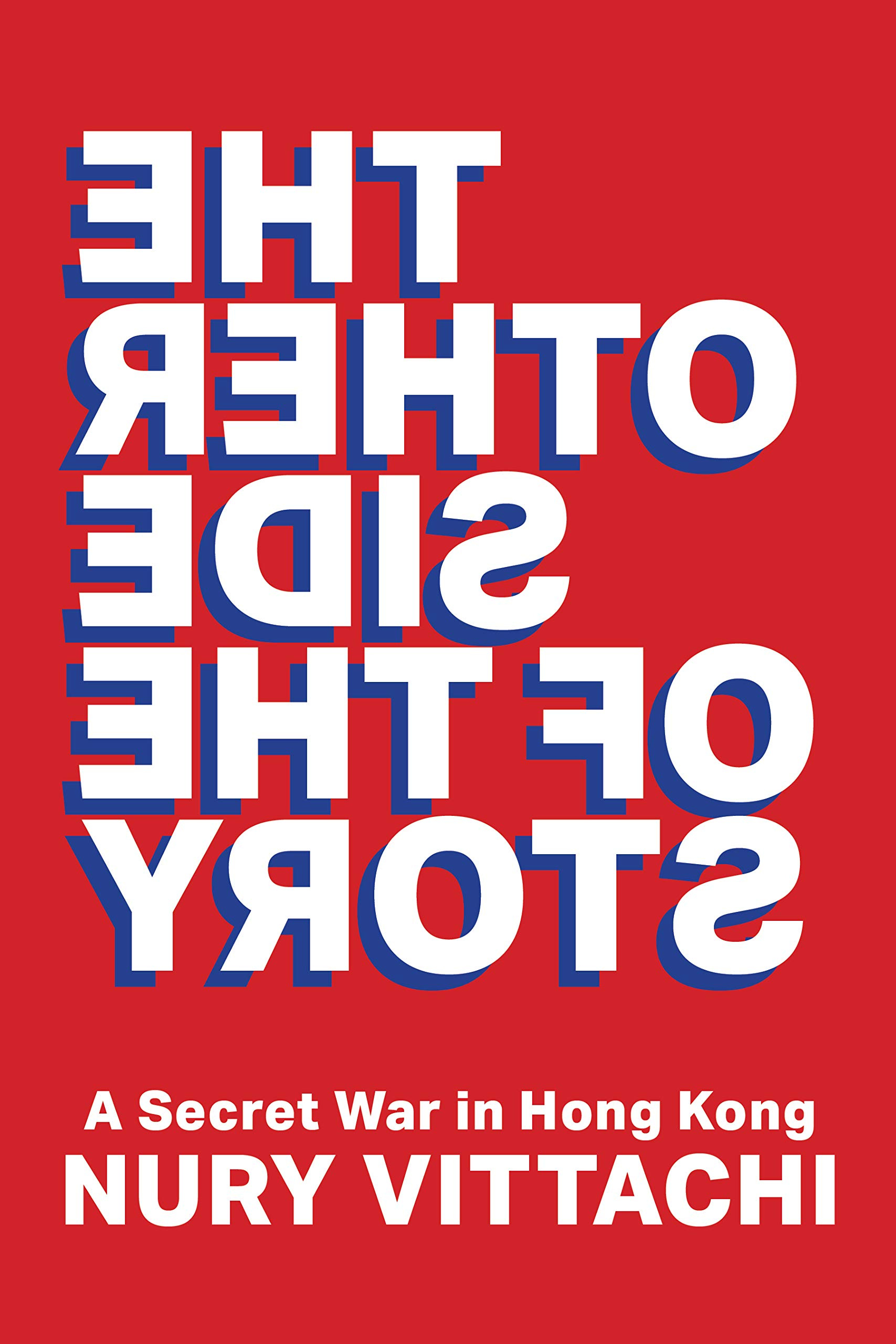
Book introduction by goodreads
One of the World’s most peaceful, orderly communities is suddenly struck by a sustained outbreak of violent radicalism. Police unmask the youths they’ve arrested to find many are children, as young as 10 years old. Behind them are shadowy groups with millions of dollars. And at every battle are pictures of the world’s most powerful Xi Jinping and Donald Trump. Hong Kong’s civil unrest was the most reported news story of 2019 – yet every salient detail presented was incorrect. There was never a proposed law to deport Hong Kong dissidents to China. The city’s freedoms had not been removed. No two-million-person march took place. Police killed no one. No trains took arrested students to mainland jails. and agents from a global superpower were intimately involved – but it wasn’t China.
Book review 1
By Daniel Dumbrill (YouTube) in conversation with author Nury Vittachi
Book review 2

Click on picture to read review
By Walter’s Blog (December 2020)
BOOK: After Autonomy: A Post-Mortem for Hong Kong’s first Handover, 1997–2019 (2022)
by Daniel F. Vukovich (Associate Professor in the School of Humanities at Hong Kong University and author)
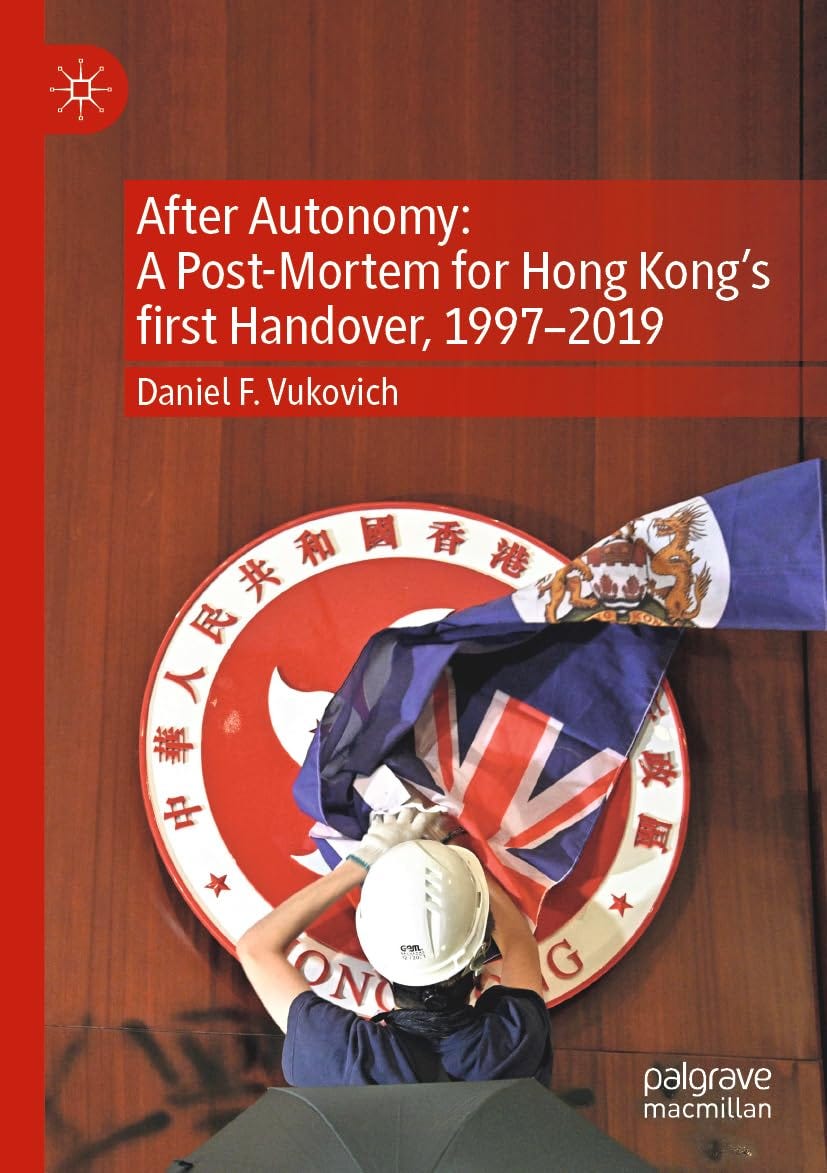
Book introduction by goodreads
This book offers a sharp, critical analysis of the rise and fall of the 2019 anti-extradition bill movement in Hong Kong, including prior events like Occupy Central and the Mongkok Fishball Revolution, as well as their aftermaths in light of the re-assertion of mainland sovereignty over the SAR. Reading the conflict against the grain of those who would romanticize it or simply condemn it in nationalistic fashion, Vukovich goes beyond mediatized discourse to disentangle its roots in the Basic Law system as well as in the colonial and insufficiently post-colonial contexts and dynamics of Hong Kong. He examines the question of localist identity and its discontents, the problems of nativism, violence, and liberalism, the impossibility of autonomy, and what forms a genuine de-colonization can and might yet take in the city. A concluding chapter examines Hong Kong’s need for state capacity and proper, livelihood development, in the light of the Omicron wave of the Covid pandemic, as the SAR goes forward into a second handover era.
Book review 1
Professor Kerry Brown, Director of the Lau China Institute and Dr Xin Fan, Director of Studies in Asian and Middle Eastern Studies at Cambridge University in conversation with author Daniel F. Vukovich
Book review 2

Click on picture to read review
By Nury Vittachi, published in Pearls & Irritations (Sept., 2023) and FRIDAYEVERYDAY (Sept., 2023)
Weekend’s Poem
The Endless Chaos of the World
The Endless Chaos of the World

Formal Title: Passage from the Romance of the Three Kingdoms 《三国演义》

By Luo Guanzhong (罗贯中, c. 1330–1400), Yuan dynasty author, historian

纷纷世事无穷尽,
天数茫茫不可逃。

Worldly affairs are endless and chaotic,
while Heaven’s will is vast and inescapable.
This passage was translated and published by Jian Xu, a Beijing-based attorney with a love for classical Chinese wisdom on Chinese Wisdom Express, accompanied by contextual notes and an introduction to the poet.
Interested in reading more Tea & Threads weekend reads? Visit Tea & Threads in the top menu or subscribe to China21 Journal to receive them, and other essays and articles directly in your mailbox.
Enjoy your weekend !
June 6, 2026
Gordon Dumoulin - China21 Journal


